

The title of this one is clearly inspired by episode titles of the famous comedy series F.R.I.E.N.D.S. But actually, this is about a much more groundbreaking sitcom from 1990s that influenced a lot of sitcoms that millennials and later generation enjoy today. Both metaphorically and literally speaking, The One Before FRIENDS, of course, is SEINFELD.

The One Before F.R.I.E.N.D.S – Voice of Sayar Henry
Hello ladies and gentlemen, boys and girls, this is yours truly, Sayar Henry, and thank you for listening to another episode of my podcast. This week, I thought to myself that the topic of my last episode was a little bit too heavy and depressing for some listeners as it had something to do with preparing for or facing death. So today, I’m going for a lighthearted topic that might cheer you guys up. And as many of you may have already noticed from the title of this episode, I’m going to talk about a TV series.
And it’s not just another TV series. It’s one of the best from the 90s and probably the most influential sitcom ever made in the history of American television. But unfortunately, a lot of young people in Myanmar are not familiar with this show probably because of the generation gap. Even if you were born in the 80s and grew up in Myanmar in the 90s, the most popular American sitcoms you would have come across would be the big hits like FRIENDS, How I Met Your Mother, and The Big Bang Theory.
But in fact, the global popularity of these shows owes largely to the ever-growing access to the internet since the year 2000, which enabled fans to spread good words about their favorite shows far beyond what conventional television networks could do.
In another word, it was a lot harder in the 80s and 90s for TV shows to reach the level of success and popularity that FRIENDS got. But even with that challenge, there was one sitcom that not only managed to beat FRIENDS with the ratings throughout the 90s, but also paved the way for many sitcoms that we would come to know today.
So, without further ado, let me introduce you to the big brother of modern sitcoms: Seinfeld.
To give you a better sense of why Seinfeld was the king of sitcoms before the era of FRIENDS, and how it was regarded as the most groundbreaking show that was ahead of its time, I first need to talk about the origin of this great show.
In the late 1980s, Jerry Seinfeld was a rising star in the world of comedians. Because of his sharp sense of observational comedy, an American television and radio network known as NBC offered him with an opportunity to create a sitcom based on his stand-up comedy experiences, but with a team of people that had never made any sitcom in their lives. The result was a pilot episode that was a bit too bizarre and somewhat unique for people to watch compared to what was available on TV at that time. And it was also a bit different from what the show would continue to become in later episodes. However, it is truly amazing to learn that the unconventional portrayal of characters and intentional lack of plots in the first episode was carried on and improved upon episode after episode, season after season, from 1989 to 1998.
I mean .. think about it.
Seinfeld has attracted millions of viewers not just throughout its run for 9 seasons before the year 2000. It is still going strong even after two decades later. There really must be something about this show, isn’t it?
So, let me talk a bit about the characters of this show.
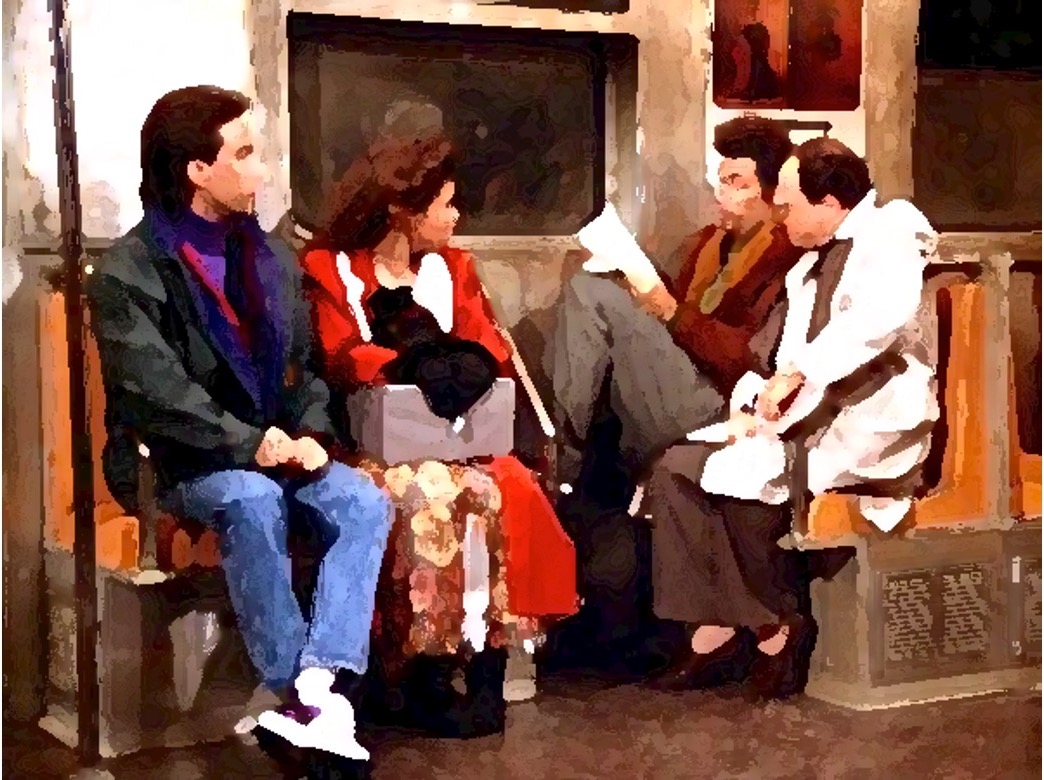
There are four main characters: Jerry Seinfeld as a fictionalized version of himself; his best friend George Costanza; his next-door buddy Cosmo Kramer; and Elaine Benes who is Jerry’s ex-girlfriend. They are four singles living in New York City and are never able to succeed in their romance department. In most episodes of the first three seasons, there are cutscenes of Jerry working as a stand-up comedian just like in real life, making brilliant jokes that are partially related to the misadventures that he and his friends go through in each episode.
Jerry: “… I don’t get it okay? I admit. I am not getting a signal. I am not getting it. Women.. They are so subtle. Their little… Everything they do is subtle. Men are not subtle. We are obvious. Women know what men want. Men know what men want. What do we want? We want women. That’s it. It’s the only thing we know for sure. It really is. We want women. How do we get them? Oh.. we don’t know about that. …”
Now here is the interesting part: none of these characters are likeable persons.
I mean, if they were for real, you wouldn’t want to put yourself in their group.
Most of the time, they are self-absorbed, sarcastic, jealous, crazy and they would ditch each other for their own interests. You would even think hanging out with them or getting caught in their group dynamic would do more harm than good for you.
In its simplest form, an average episode of Seinfeld would look something like this: Jerry would be seeing a girl; Elaine would be making some poor choices in men or something accidental in her workplace; Kramer would be wildly pursuing his ridiculous business ideas; and George would be misbehaving at his job or in his relationship. Each of them would never fix their flaws but foolishly hope to achieve something better. Then somehow by the end of the episode, they would always be back to square one because of their flaws and their group dynamic. And in between, they would go through awkward situations that would create many hilarious moments.
And most notably, it’s a show that was created to focus on nothing – literally nothing – with no forward plots, no hope for love affairs, no interesting stories, no character development or journey, no emotional rollercoaster, and no learning or lesson of any sort. The creators just wanted to show the audience how comedians get their material based on the little details of everyday life. Regardless of this nothingness, people love the show because they can relate to these everyday situations, the exaggerated character flaws, and the intelligently crafted dialogues and jokes.
Now, allow me to explain it better with an example. You see.. at one point in our life when we feel hopeless about something or are tired of trying the usual ways, we tend to imagine what would happen if we did the opposite. You know… sometimes, we try things that are counter-intuitive and somehow get a better result than what we normally do in conventional ways. This kind of life experience was depicted in one of the episodes.
Elaine: George, you know … that woman just looked at you.
George: So what? What am I supposed to do?
Elaine: Go talk to her.
George: Elaine, bald men, with no jobs and no money, who live with their parents, don’t approach strange women.
Jerry: Well, here’s your chance to try the opposite. Instead of tuna salad and being intimidated by women, chicken salad and going right up to them.
George: Yeah… I should do the opposite. I should.
Jerry: If every instinct you have is wrong, then the opposite would have to be right.
George: Yes. I will do the opposite. I used to sit here and do nothing and regret it for the rest of the day. So now I will do the opposite and I will do something.
George: Excuse me. I couldn’t help but notice that you were looking in my direction.
Woman: Oh yes, I was. You just ordered the same exact lunch as me.
George: My name is George. I’m unemployed and I live with my parents.
Woman: I’m Victoria. Hi!
One of the other great things about Seinfeld was that it materialized the concept of meta-humor and self-referential elements. At one point in Season 4, Jerry and George started to talk about how they may be able to pitch the idea of ‘a show about nothing’ to the executives of NBC, introducing the audience of 1990s to the concept of a show within a show.
Listen to this clip.
George: I’m really serious. I think that’s a good idea.
Jerry: Just talking? What’s the show about?
George: it’s about nothing.
Jerry: No story?
George: Forget the story.
Jerry: You gotta have a story.
George: Who says you gotta have a story? Remember when we were waiting for that table in a Chinese restaurant that time? That could be a TV show.
Jerry: And who’s on the show? Who are the characters?
George: I could be a character.
Jerry: You?
George: Yeah, you base a character on me.
Jerry: So on the show there’s a character named George Costanza?
George: Yeah. What? There’s something wrong with that? I’m a character. People are always saying to me you know you are quite a character.
Jerry: And who else is on the show?
George: Elaine could be a character. Kramer!
Jerry: He’s a character. So everybody I know is a character on the show.
George: Right!
Jerry: And it’s about nothing.
George: Absolutely nothing.
Jerry: So you’re saying I go in to NBC and tell them I got this idea for a show about nothing.
George: We go in to NBC.
Jerry: We? Since when are you a writer?
George: What writer? We’re talking about a sitcom.
Jerry: you wanna go with me to NBC?
George: Yeah I think we really got something here.
Jerry: What do we got?
George: An idea!
Jerry: What idea?
George: An idea for the show.
Jerry: I still don’t know what the idea is!
George: It’s about nothing!
Jerry: Right.
George: Everybody is doing something. We will do nothing.
Jerry: So we go in to NBC, we’re telling we get an idea for a show about nothing.
George: Exactly!
Jerry: They say what’s your show about, I say nothing.
George: There you go!
Jerry: I think you may have something here.
In today’s standard of sitcoms, there must be some ‘hook’ that can grab the attention of viewers quickly from the first episode. In FRIENDS, it was this ‘will-they-won’t-they’ tension between Ross and Rachel. In How I Met Your Mother, it was ‘the unknown mother’ of Ted Mosby’s kids. So, from the viewers’ perspective, these shows are leading them to a future destination. The show makers play around with our curiosity and force us to follow the characters’ journey by hooking one season to the next. Not that there’s anything wrong with that, but with Seinfeld, it was different. There was no ‘hook’ or ‘trick’ or ‘journey’ that will force us to watch one episode after another. Back in these days, people were a lot more patient than today. There were no smart phones, and people were not addicted to instant gratification like we are today. So there was no need for them to attract the viewers with some ‘hook’. The show’s existence relied purely on solid comedy, and that is probably one of the reasons why people can watch the whole series over and over again to this day.
For example, when I started watching Seinfeld, it took me more than 10 episodes to get used to with the style of each episode and the nature of the four characters, and to notice how the jokes are much more brilliant and intelligent than that of FRIENDS.
Jerry: “… so they’re showing me on television the detergents are getting out blood stains. Is it some violent image to anybody, blood stains? I mean… come on, you got a t-shirt with blood stains all over it, may be laundry isn’t your biggest problem right now.”
Then, as I was writing script for this episode that you are listening right now, I watched the first two episodes of Season 1 to make sure I know what I’m talking about. And to my amazement, now that I completely get what this show is about and how the characters are built, these early episodes become even more funnier than what I felt when I watched these the first time around. That’s when I realized the value of Seinfeld. It also gave me a grasp of why Netflix paid over 500 million dollars to get the global streaming rights for this sitcom from 1990s.
So, the question for me now, as a language teacher, is to tell you whether or not you should watch this classic comedy show with the purpose of language learning. And the more I think of it, the more I realize the answer is both YES and NO at the same time.
The reason for YES is that there are many parts of the show that are based on everyday situations and related quick conversations that most learners of English can understand and appreciate. But then again, there are many parts that are heavy with cultural references of the 1990s and thus some learners may not get these jokes regardless of their language level, which kind of defeats the purpose of watching a sitcom. And since there is no storyline to carry you, when you can’t understand the culture references, all you have is your language skill to tap into the show’s comedy style. On the other hand, however, if you can understand the implication of some metaphors and catchphrases established throughout the series, it becomes so much more rewarding and amusing to watch the show.
So my recommendation for most learners is to use Seinfeld not as a source of learning material, but as a testing material that can help you observe how well you understand the use of language in forming comedy and how language is associated with the sense of humor.
Well, it’s been long enough and it is time for my closing remark for this episode.
Seinfeld is considered as one of the greatest sitcoms that was ever made in American television history. Its originality, its unconventional use of flawed and neurotic characters that we don’t want to become, and its clever comedy in everyday situations we can relate to revolutionized the way most sitcoms were made. It inspired the next generation of TV shows such as FRIENDS, and How I Met Your Mother, and it also paved the way for shows that use dark humor such as It’s Always Sunny in Philadelphia.
Jerry: What happened in the game anyway?
Kramer: What happened? Well, they stank! That’s what happened!
Without Seinfeld, many of the shows that millennials and later generation love so much today wouldn’t even exist. So, next time, when you are looking for a sitcom to invest your time in, put Seinfeld in the No.1 spot of the speed dial of your old telephone. You’ll become a master of that domain.
Kramer: You got any meat?
Jerry: Meat? I don’t know. Go…. Hunt!


 SH Learning Culture